
Showing posts with label discernment. Show all posts
Showing posts with label discernment. Show all posts
Wednesday, February 11, 2015


Tuesday, August 07, 2012
Colorado Learnings: The Upward Way
 I'm a flat-lander. I readily admit that. A child of the Midwest, that region is my home in many senses. I'm rooted and grounded there and love its seasons, flora and fauna.
But i like to travel, too. I enjoy seeing different parts of God's good earth. This summer I've seen the Carolina coastline, northern Ohio farm fields, and Colorado's mountains.
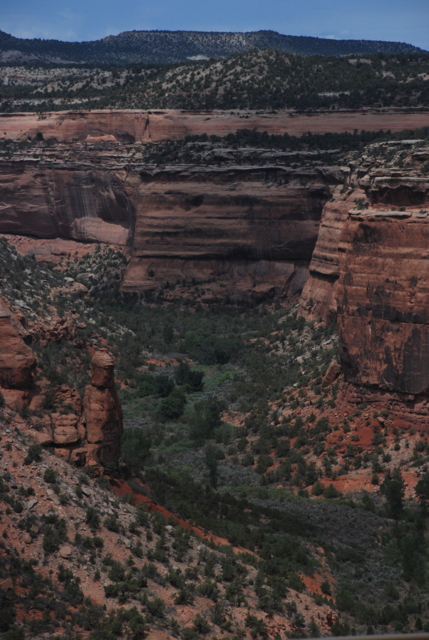
Yesterday I did something I would not, on my own, choose to do. I went on a ride at Colorado National Monument.
Now unlike the the Washington Monument, which I have seen many times whilst in DC, there is no ... um... monument at Colorado National Monument. There's no stone spire there, no man-made monolith. Instead the whole place is a geologic monument. With sheer cliffs dropping 2,000 feet.
That last part is why I would not choose to take a ride there. I'm not a big fan of sheer drops of 20 feet -- let alone 2,000 feet. But my sister Julie and her husband Dave wanted me to see this particular part of their state and my sister Linda who is almost as heights-impaired as I am, said she was game, so off we went.
I was fine at first. Didn't really think much about it. But they kept talking on the almost 2 hour trip from Montrose to the park entrance about how it wasn't so bad and which side of the car I should not sit on and how I could keep my eyes closed on the way up, if I wanted.
All that made me a mite jittery. So did, upon our arrival at the park entrance, Linda saying, "Okay, let's switch seats." She said it was so I could have the best views for photos, but it was really because she wanted to be on the side of the car facing the solid rock walls instead of the sheer (I have I mentioned that the drops offs are sheer?) drop onto the rocks below.
I was still pretty much okay. Until a car pulled up next to us. The driver and passenger looked up at the roads clinging to the side of the rock face, looked at each other, looked up again, looked back at each other ... and turned around and left.
I took a deep breathe, we pulled up to the ranger station, got our sticker and started up a gentle climb. I looked at the map the ranger had kindly given us just as the road took a decided un-gentle angle of descent and all guard rails disappeared (to make it easier for the car to plunge all the way to the bottom of Fruita Canyon I guess). According to the map, ahead lay Dead Man's Curve.
My goal was to make it there -- and past.
My hands were sweaty, my breathing shallow. I wanted to lean to the inside to "help" keep the car on the road (unknown forces were probably at work trying to suck us off the road). I wanted to close my eyes. But instead, I reminded myself to breathe deep. I sat back. I wiped my hands on my shorts. I stole small glances out the side window while Julie and Dave "ooohed" and "aahed." I admitted to myself and them that I was scared. And I told myself that soon I would be at a place that was more comfortable to me than an automobile climbing along the edge -- and would be witness to some vistas that I'd never witness any other way.
Like life, I thought. I'm in the midst of a sort scary trek now... after having left a long-term, solid, well-paying, fulfilling position with a wonderful organization to do ... to do what? To find another solid, well-paying, fulfilling position with a wonderful organization? To write, edit, speak, lead retreats, consult with churches?
The road I'm on looks pretty scary in some ways. But the safety of the flatlands is behind me. I'm on the climb. The cliffs look pretty sheer. But, like yesterday, I'm in good company. Many other of God's children are traveling similar paths, and some are with me on mine.
And, like yesterday, I have a driver and guide who's trustworthy and knows the terrain, even if I don't. So, like the old gospel hymn says:
I'm pressing on the upward way
New heights I'm gaining every day;
Still praying as I'm onward bound,
“Lord, plant my feet on higher ground.”
Now, if I can just make it past "Dead Man's Curve."
-- Brent
Wednesday, May 23, 2012
Brent's Books On Kindle
 I'm happy to announce that Mind the Light is now available on Kindle. Mind the Light was first released in paperback in 2006.
 When it was released, Publishers Weekly said, "Those seeking a series of clever tips for cultivating spiritual growth overnight will not want to delve into this deceptively simple meditation on the Quaker custom of mindful seeing. A Friends minister and author of Holy Silence: The Gift of Quaker Spirituality, Bill describes his book as "a way of seeing our inner and outer lives with spiritual eyes and discovering the connectedness between inner and outer sight." Like a neighborly conversation across a kitchen table, this slender volume emphasizes the mundane details of daily life as they are enlightened by being attentive to the Spirit of God that Quakers believe dwells within each person."
While it's still available in limited quantities on-line and in bookstore, it has been declared out of print by the publisher. So I've been able to make Mind the Light available, as originally printed, as a Kindle book -- for the low price of $2.99.
 For those of you who like Kindle, a few other of my titles are also available there.
 Sacred Compass: The Way of Spiritual Discernment was called by Richard J. Foster "one of the finest books on discernment and divine guidance that I have seen in a very long time."

 Holy Silence: The Gift of Quaker Spirituality has also recently been released on Kindle. Publishers Weekly said, "In this brief primer on Quakerism in general and silence in particular,
the author uses a practical tone to anchor reflections on what is
essentially a matter of mystery: how God speaks in and through
individual and communal silence. A self-confessed "type A personality,"
Bill brings a buoyant but realistic tone to his subject. Interspersed
with quotations from various Christian writers and pauses for "quietude
queries," or reflective moments for relaxation and contemplation, the
slim volume is a useful tool for readers seeking a guide to devotional
practice."
Holy Silence: The Gift of Quaker Spirituality has also recently been released on Kindle. Publishers Weekly said, "In this brief primer on Quakerism in general and silence in particular,
the author uses a practical tone to anchor reflections on what is
essentially a matter of mystery: how God speaks in and through
individual and communal silence. A self-confessed "type A personality,"
Bill brings a buoyant but realistic tone to his subject. Interspersed
with quotations from various Christian writers and pauses for "quietude
queries," or reflective moments for relaxation and contemplation, the
slim volume is a useful tool for readers seeking a guide to devotional
practice."Coming soon is a new edition of David B. Updegraff: Quaker Holiness Preacher. So far this is the only modern biography of this radical Quaker preacher of the 19th century. 2013 will mark the 30th anniversary of the publication of this landmark work. The new Kindle version will be an expansion of the 1983 edition and will include research I have done since that edition was originally published.
Enjoy -- happy reading!
-- Brent
Monday, April 30, 2012
Fifty Acres and a Fool: West of Eden (Not Quite Paradise)

How did I get here? That’s what I wondered nine years ago, wading through waist-high weeds and the moist summer Indiana air that swarmed with mosquitoes. I knew what I was doing there: I was meeting with our builder and talking about the house we were building. But how I got there was completely beside me.
I looked through the tall grasses and weeds and spotted my bobble-headed wife. Her head bounced up through the weeds, down into the tall grass. She stepped back onto the sort-of farm lane above the creek, a huge smile stretched across her face. “Isn’t this gorgeous?” she asked. “Aren’t you just so excited? This is paradise.” Excited and paradise were words that had not occurred to me. Hot. Sweaty. Itchy. Debt-laden. Those words occurred to me, but not excited and paradise.
Nancy’s a farm girl, and this land was part of her family’s farm. I grew up a city boy. I like the city. I work in the city. Now, here I was, miles away from my downtown office and over fifteen hundred feet away from the closest road with no blacktop in sight. How did I get here?
I wonder if Adam wondered the same thing upon finding himself waking in Eden. “And the Lord God formed man of the dust of the ground, and breathed into his nostrils the breath of life; and man became a living soul. And the Lord God planted a garden eastward in Eden; and there he put the man whom he had formed.” Yes, the Bible says, “And out of the ground made the Lord God to grow every tree that is pleasant to the sight, and good for food,” which must have made for a lovely sight, but I still keep wondering if Adam asked himself, How did I get HERE?
Since that day – and all the chain-sawing, stump-pulling, poison ivy-treating, tree seedling-planting, prairie-seeding, bush honeysuckle battling, et al --what I’ve discovered is that this is not entirely the right question. It’s not the right question because “How did I get here” implies that my being where I am is all about me. It’s not. It is about me, but not all about me. It’s also about:
· Nancy
· our families
· wildlife crawling across the land
· the home we open up to others in hospitality
· and all the other connections I have
I knew this truth intellectually, but it’s only as I begin being “the man not born to farming,” that I’ve struggled to come to grips with it. I’m not the center of even my universe. As Nancy reminds me, it’s only one–six billionth about me.
My tending the land reminds me of the communal nature of my life. Moving to this piece of land and building a house on it allowed Nancy could to be close to her father and some of her literal roots. It also gave me a literal space in which to follow my leading to form a worship-sharing group. It also forced me to slow my life by spending hours in a tractor seat or walking in the woods rooting out invasive plants and learning to watch good things grow.
This farming stuff invites me to live in harmony with a sentiment by Gordon Matthews:
We must learn to put our trust in God and the leadings of the Spirit. I am only slowly learning to dwell in the place where leadings come from. That is a place of love and joy and peace, even in the midst of pain. The more I dwell in that place, the easier it is to smile, because I am no longer afraid.
If we dwell in the presence of God, we shall be led by the spirit. We do well to remember that being led by the spirit depends not so much upon God, who is always there to lead us, as upon our willingness to be led. We need to be willing to be led into the dark as well as through green pastures and by still waters. We do not need to be afraid of the dark, because God is there. Let us walk with a smile into the dark.
Now, walking with a smile into the dark—the unexpected place of the farm for me—is not something that comes easily to me. Even after nine years of getting ready to move here and seven years of actually turning the land into a wildlife preserve. I’m the sorta guy who still looks over my shoulder to see who’s following me up the stairs when I shut off the basement light.
Yet, walking (or driving a tractor) into the metaphoric dark with a smile reminds me that life is not all about us. Life is about me and God and. . .
-- Brent
Sunday, May 09, 2010
Spiritual Discernment-- Life in Motion
Trusting that God directs our paths teaches us to see the ways life opens. Our lives are filled with potential “a-ha” moments. Following our spiritual compass helps us see the “a-has”. Trusting God also allows us to be real and genuine and authentic people, because trust helps us be more aware of the circumstances through which we pass. We see our flaws and frailties, and can still embrace the fact that we are people who hunger after God and are instruments of God.
The early Quaker mystic Isaac Penington said:
"Know what it is to walk in the path of life. . . . It is that which groans, and which mourns; that which is begotten of God in you. . . . The true knowledge of the way, with the walking in the way, is reserved for God’s child, for God’s traveller. Therefore . . . don’t strive to be any more than God has made you. Give God your will . . . and, sink down to the seed that God sows in the heart and let that grow in you. "
I love the idea that “The true knowledge of the way, with the walking in the way, is reserved for God’s child, for God’s traveller.” As I look at my life, I see one of motion. Though firmly rooted in the Midwest, as an adult I’ve lived in sixteen houses in two states, held fifteen full- or part-time jobs, and owned too many cars. Your life may be less frenetic than mine, but I’m sure that as you look over your history you’ll see various movements in your life as well—careers, family, spiritual, and physical changes. The movements all fit with the concept of way opening. Way opening implies motion; a moving along life’s pilgrim way. What a winsome discovery.
-- Brent
The early Quaker mystic Isaac Penington said:
"Know what it is to walk in the path of life. . . . It is that which groans, and which mourns; that which is begotten of God in you. . . . The true knowledge of the way, with the walking in the way, is reserved for God’s child, for God’s traveller. Therefore . . . don’t strive to be any more than God has made you. Give God your will . . . and, sink down to the seed that God sows in the heart and let that grow in you. "
I love the idea that “The true knowledge of the way, with the walking in the way, is reserved for God’s child, for God’s traveller.” As I look at my life, I see one of motion. Though firmly rooted in the Midwest, as an adult I’ve lived in sixteen houses in two states, held fifteen full- or part-time jobs, and owned too many cars. Your life may be less frenetic than mine, but I’m sure that as you look over your history you’ll see various movements in your life as well—careers, family, spiritual, and physical changes. The movements all fit with the concept of way opening. Way opening implies motion; a moving along life’s pilgrim way. What a winsome discovery.
-- Brent
Friday, May 07, 2010
Getting Lost Along the Way
 Awhile back I spent a delightful afternoon at the annual Gathering of Friends General Conference in Johnstown, PA. I'd been asked to do a reading from Sacred Compass, which went well. The audience seemed engaged, they asked some questions, and a good discussion ensued.
Then, after chit cat and signing some books, it was off to Indiana. Nancy read the Mapquest directions and I followed her well read instructions. In spite of that, I soon stopped seeing signs that said Route 219 very quickly.
After a mile or so, I pulled over and pulled out our road atlas and looked at the Johnstown mini-map and looked. It appeared that so long as I continued south on the road we were on, we'd run into Route 219.So south we continued -- right into the heart of downtown Johnstown and "Thunder in the Valley," a huge annual motorcycle event.
Everywhere I looked was a motorcycle but nowhere I looked was a street where it was supposed to be.
Especially no Route 219 heading toward the interstate.Finally, Nancy spotted a sign that said "To 219" and up the ramp we went.
The opposite direction from where we'd be going.
It didn't make any sense -- why would we go north to find the road going south? And why were none of the roads where they were supposed to be?Ten miles later we came an exit for Route 219 -- 1/2 a block from where I originally turned on to the road that led to 219. How can that be, I wondered?
As I merged into the swiftly moving 219 traffic, I glanced up at the mirror and noticed the compass embedded in it. It told me I was going south -- and had been since we got on the road that said "To 219."
Which also told me that when I thought I was going south earlier, I had actually been heading north -- and had been moving away from my destination the entire time.
That's why MapQuest and the road atlas were worthless -- I was reading them "upside down."
All I needed to do to get going right was to look up at the compass. I would have seen clearly that I was going north, not south, and turned around.This all reminded me that it is precisely when I am certain that I'm going the right direction that I need most to check my compass. And in this case, I'm not talking about the one in the car. I'm thinking here about my sacred compass; the work of the Holy Spirit in my life. I may have checked the maps, the weather, the road conditions, and my own sense of direction -- but that may not be enough.
The car's compass was there. I just needed to consult it. The same is true of my soul's compass. Even -- or maybe especially -- when I've just finished a reading telling other people to consult their's.
- Brent
Wednesday, May 05, 2010
As Way Opens: A Path of Discernment
 Where am I supposed to go with my life? That’s the question. “To be or not to be,” is profound and fine for a Shakespearean drama, but if we’re asking the “What am I supposed to do with my life” question, then “To be or not to be” is moot. We be. Now what? The “where” question is as universal and old as humankind. It is as personal and contemporary as each one of us alive today. It especially presses upon those of us who sense that we are not merely human trying to be spiritual, but rather that we are deeply spiritual endeavoring to live as fully human. We begin our days with that “what” question. We awaken every morning with a cavalcade of choices before us – beginning with whether to even get up or not. Things get more complicated from there. The very act of making a choice – any choice -- takes us deep into the concept that our lives are more than our own. We belong to ourselves, to be sure, but we also belong to others in our lives. And most of all we belong to God. And God has plans for us. At least that’s what faith and a good deal of religious training tells us.
When I was in college I encountered a group handing out little buff colored booklets titled “The Four Spiritual Laws.” The first spiritual law was "God loves you and has a wonderful plan for your life." That’s not a novel concept. It’s firmly rooted in Christian scriptures. The Bible and the whole of Christian history is full of examples of people seeking to determine what God wants them to do. They cast lots, set out fleeces, prayed, fasted, learned to listen to donkeys, went on retreats, climbed up on cacti, and more. Bookstores are crammed full of titles about learning God’s will – Amazon alone offers more 38,000 books on the subject in its religion section.While some of these books will offer you five easy steps for discerning what God’s directions are for you, this is not one of them. It is also not about taking charge of our lives in the accepted, self-help best-seller sense. It is not about twenty-one indispensable qualities of a leader or seven highly effective habits.
That’s because coming to an understanding of God’s direction for us is not that simple. It’s also amazingly countercultural – about learning to stop and pay attention rather than shouting and demanding attention. If we want to know what God wants, we have to go to a deeper place than a set number of habits or qualities and become men and women of spiritual quality and the habit of looking for God in every place our life takes us.
That deeper place takes us to the discovery that the act of deciding to seek God’s direction for our lives changes us. We find that such spiritual discernment is more about sensing the presence and call of God than it is about making the right decision. In a grace filled way, this process of discovery awakens us both to a life of constant creation and recreation. It shows us how we are less about being right or making the correct decisions than we are about the work of transforming ourselves. And in the process, we are also transforming the lives of the people around us and ultimately the world. When we pay attention, this is something our souls intuit, but it’s harder to get our minds around. What we do see is that nothing that involves transformation can be accomplished by a recipe found in The God’s Will Cookbook – take one dash of Bible, three tablespoons of prayer, and bake in the oven of God’s light.
Instead, at the heart of discovering God’s direction is contained in the wisdom of the Quaker saying “as way opens.”
Friends drop this tiny phrase into conversation as easily as other folks do “Hello” or “How’re you doing?” “Will you be coming for dinner tomorrow?” asks one. “I will, if way opens,” answers the other. In some ways, it’s our version, in daily conversation, of “Lord willin’ and the creek don’t rise.” It’s become almost a Quaker cliché.
But, as with all clichés, there’s powerful truth lurking in this quirky Quaker conversational pattern. That truth is the belief that God’s revelation, even in and integral to daily life, continues for those who seek God’s way. God is at work within and around us, leading, guiding, sometimes when we least expect or feel it.
“As way opens” comes from a bit larger phrase, “To Proceed as Way Opens.” This means “to wait for guidance, to avoid hasty judgment or action, to wait for future circumstances to help solve a problem. The spiritual guidance which may come in a time of seeking or entirely unexpectedly, bringing suggestion for previously unforeseen action.”
As way opens about more than one time spiritual discernment. While its lessons can be used to help us make major life decisions – careers, life partners – and minor ones, as way opens is about a form of Christian discernment that takes us to the heart of the Christian life as living in God's will. It’s about discovering a fresh and deeper way to live a God directed life – a life that eschews simple spiritual solutions and takes us to the deepest, most soulful parts of our being.
It is about learning from God in the daily and life long.
As way opens is how we can come to see our lives, with all their experiences good and bad, as God-directed
-- Brent
Monday, May 03, 2010
Compass, Maps, & the Will of God
 Compass. As a kid the very word conjured images of treks across trackless wastes, blazing trails through primeval forests, and other adventures unavailable to city boys. I didn't need a compass in a city composed of north-south avenues and east-west streets. One block north, two blocks west, two more blocks north and I was at my grandparents. Simple. Straight. No adventure.
"Compass" still hold an aura of mystery for me today in this time of GPS and turn by turn directions issuing out of my car's stereo speakers. It still implies a journey where no navigation DVD has gone and no satellites peer. And while there are few of those in my business life, they abound in my spiritual life.
Unlike GPS and other wonders of modern direction finding, a compass does not give us step by step steps to our destination. It does, though, no matter what direction we turn, always point us to true north -- a destination most of us (unless we're named Amundsen, Byrd, Peary, or Henson) never reach in this lifetime. This is a metaphor for our spiritual lives and the work of discerning God's will for them.
There are many times I wish God would speak as clearly and as obviously as Mapquest or GoogleMaps. But the life of faith is not that way. Instead our sacred compass (the work of God's Spirit within us) points us to our spiritual true north -- the mind and love of God -- and asks us to travel by faith and use the various maps we've been given. Things like spiritual friends, the Bible, prayer, and other faith practices. Our sacred compass is that which is embedded in our souls that calls us to life with God -- life abundant and adventurous, even during those times we wish it was less so.
So, what "maps" do you use to help make sure you're following your sacred compass?
-- Brent
Sunday, January 17, 2010
30 Days of Touch -- Markers
 I taught Sunday School today. For the second week. This was something I had vowed I would never do again after my friend Stan Banker asked me (20 years ago) to teach a six week course on Quakerism at First Friends in New Castle, Indiana. That six weeks turned into six years! I didn't quit teaching; I retired. Ha.
In spite of my vow, I did sign up to teach some sessions on Sacred Compass at West Newton Friends where I've been attending. Last week we drew our LifeMaps and this week we did Call Charts (places where the call of God has broken through in our lives). We use big ole flip chart paper and colored markers.
I brought lots of markers -- thin, fat, scented, unscented, vibrant colors, muted pastels. Most people seemed to enjoy the exercise. I'd like to think that was because it had some spiritual significance, but even if it was just that they got to play with markers, well, that is fine by me.
I know I enjoyed the markers. The first one I picked up was a fat barreled scented marker. Licorice. Black licorice. Which I love. Ymmm. Then I used a thin pale blue marker, no scent at all. Just for fun, when no one was looking, I made a little dot on my hand... just to see what it would do.
It's still there, faint. The color that was so smooth and vibrant on the chart paper, is faded and .... hmmmm.... wrinkly textured on my hand.
Which made me think about the textures of my spiritual life. They are many. Some are smooth -- like the times when I felt in complete sync with God and the marker of my life moved easily across the paper. Others were rough, like trying to draw on a piece of sandpaper. The marker skipped and jumped and I really had to bear down to leave a mark.
I think that describes some of my most obstinate times.
At other times, the marker was fine, but the surface was slick. Beyond smooth -- it was glossy and did not seem to take the color. It would smear if even lightly touched. I think those were the times that I was a young know it all. I had all the spiritual answers and so really didn't need God's help in thinking things through. I had already thought them through, thank you very much.
What are some of the textures of your life? And how do they speak to you?
Now, after thinking about that licorice scented marker, I think I'll go get a piece of licorice!
-- Brent
Saturday, October 17, 2009
Quaker Wisdom for Today
Being orderly come together, [you are] not to spend time with needless, unnecessary and fruitless discourses; but to proceed in the wisdom of God, not in the way of the world, as a worldly assembly of men, by hot contests, by seeking to outspeak and over-reach one another in discourse as if it were controversy between party and party of men, or two sides violently striving for dominion, not deciding affairs by the greater vote. But in the wisdom, love and fellowship of God, in gravity, patience, meekness, in unity and concord, submitting one to another in lowliness of heart, and in the holy Spirit of truth and righteousness all things [are] to be carried on; by hearing, and determining every matter coming before you, in love, coolness, gentleness and dear unity; - I say, as one only party, all for the truth of Christ, and for the carrying on the work of the Lord, and assisting one another in whatsoever ability God hath given."
--Edward Burrough
--Edward Burrough
Monday, August 24, 2009
Quaker Wisdom for Today
Eternal God, let thy spirit inspire and guide us. Thy will be done. Give us the strength to fulfill our task without selfishness, slothfulness, or cowardice. . . . Eternal God, we will listen to thy call and obey it in order that we may hear it ever more clearly. Give us the honesty to examine our own acts and thoughts as scrupulously and severely as those of other people. . . . Give us the quiet courage needed in all circumstances and natural to whoever has consecrated his life to thee. . . . Do not let any defeat, any fall . . . separate us from thee; in the midst of all our weakness let thy love take hold of us and little by little lift us up to thee.
-- Pierre Cérésole
Pierre Cérésole (1879-1945) of Switzerland was the founder International Voluntary Service for Peace. A conscientious objector, he found himself in prison for that stand. He joined Friends in 1936. He wrote this prayer shortly before his death.
-- Pierre Cérésole
Pierre Cérésole (1879-1945) of Switzerland was the founder International Voluntary Service for Peace. A conscientious objector, he found himself in prison for that stand. He joined Friends in 1936. He wrote this prayer shortly before his death.
Thursday, April 23, 2009
I'll Go Where You Want Me To Go, Dear Lord -- Well, Probably Not: A Bad Christian's Confessions on Faith
 I grew up dreading missionary conferences at our church. Long hours (some lasting 70-80 minutes at least!) sitting in the Fellowship Hall listening to the good missionary families drone on and on about their work in India, or Formosa, or Kenya. Endless series of slides of people with unpronounceable names (at least to my Midwest tongue/ear). The pleas for money and more missionaries -- "who out there in the congregation is feeling God's call?" It wasn't me! And then chop suey. Yes, chop suey -- no matter if the missionaries were from Kenya, India, or Formosa -- where even they didn't eat chop suey. I still hate chop suey.
Then, as things were winding down, we'd sign that old missionary hymn, "I'll Go Where You Want Me to Go, Dear Lord."
I’ll go where You want me to go, dear Lord,
O’er mountain, or plain, or sea;
I’ll say what You want me to say, dear Lord,
I’ll be what You want me to be.
Except I'd always sing it under my breath like this:
I’ll go where You want me to go, dear Lord,
Let's skip the mountain, or plain, or sea;
I'm happy right here in Ohio, dear Lord,
Africa is for others -- not me.
Yep, even as an adolescent I was a bad Christian, I guess, even though I wanted to be good. Sort of. Following God's call halfway sounded about as far as I honestly wanted to to go. My biggest fear as a kid was that somehow I would hear "the call" to Africa. Terrified me. All I knew about the "Dark Continent" came from missionary meetings and Tarzan on TV, but it was enough to know that it didn't appeal to me. So I was pretty sure that's where God would call me. The Lord and his mysterious ways, you know? God seemed like the sort of chap (and back then, God was male) who would send me right where I didn't want to go.
After all, He had a long history of doing that. Ask Jonah.
I was glad when I reached the age that my parents quit making me go to the missionary meetings. I had escaped without hearing the call.
Of course, I did sorta hear a call to other "missionary" work -- with high school kids in Young Life and various church related youth groups, as pastor in local congregations, and so on. But still, they didn't involve any huge move. Nice and safe in the Midwest. And very spiritually enriching.
But I still harbor the fear that the call will come to Africa. And I wonder what my response will be? I'm clinging to the wisdom (as I perceive it) of what the great writer and theologian Frederick Buechner said -- “The vocation for you is the one in which your deep gladness and the world’s deep need meet—something that not only makes you happy but that the world needs to have done.”
I'm trusting that God knows that I do want to go where "he wants me to go." Just, please, "dear Lord," not Africa!*
-- Brent
*of course, I know, that somehow I will end up in Africa before the end of my life. I once said, after a miserable night in a cheap hotel in a small city in Indiana (when I was from civilized Ohio) that I'd never been so glad to leave a town and would never, ever, under any circumstances return. Only to have God laugh and say, about 15 years later, "Oh yeah?" I ended up moving to New Castle and spending some of the happiest years of my life there. Hmmmmm....
Sunday, March 01, 2009
Discerning Questions
 I just returned from Memphis, Tennessee where I was presenting a series of workshops on "The Sacred Compass: The Way of Spiritual Discernment" at the Baptist College of Health Sciences. BCHS has about 900 students and focuses on undergraduate health care education. Karen Smith, the Director of Campus Ministries, did a wonderful job putting the program together and she and the students, faculty, and staff made me feel very welcome.
I ended each session by offering a "Query" for the students and staff to ponder -- based on the Quaker tradition of using questions for reflection and as spiritual exercises. The final session was titled "Discerning Questions" and I offered a whole host of queries that they could use as part of their discernment processes. And I offered them the opportunity to ask questions of me about spiritual discernment. Now, by and large, they were a pretty quiet group (I joked a time or two that I had done the impossible -- turned Baptists into Quakers -- that's how silent they were), so during the "Discerning Questions" session, I asked them to write their questions, which I would then try to answer. I hoped to get one or two really good ones and end our time together by answering things close to their hearts and souls.
I got more than one or two. And the time ran out before I could answer more than one or two. I didn't get a chance to read them all until after I got home, but when I did, I decided they were too good not to share. So here they are -- no answers, just the questions (well, most of them -- there were a couple along the lines of "Is it God's will for the Memphis Tigers to have a #1 seed in the NCAA basketball tourney?" That's just silly -- everyone knows God is Buckeye's fan).
The questions:
- What do you think is the most important tool or tools to carry with you on your journey through life toward God's will?
- In my prayers I include "Let God's will be done," but how do I know it's God's will?
- What is God's will?
- What should you do if you feel called to do more than one thing, or maybe many things. Okay, maybe so many things you don't know how you will do them all in a life span?
- What is spiritual discernment?
- Is it wrong to ask for a sign from God?
- How, after make so many journeys that have failed, do you know what direction to go?
- Why is it so much easier (or seem to be) for folks to discern God's will/plan for other people?
- It seems easier to see God's involvement through "the rear view mirror." How do we discern where God is moving ahead?
- What if you think you are going in the right direction but don't like it or feel empty about it?
- How can you effectively listen to God related to the direction one might be going?
- Should I always seek God's approval before I make any life choices?
- How do I listen and hear what God wants for me in my life?
- I feel like I'm being used to do God's work. But recently I have been feeling disconnected from God. How do I reclaim my connection to God -- to follow his plans for me?
Really good questions. Thoughtful. Important. Questions we all need to wrestle with.
As the session ended on Friday, I had time for one more question and one more PowerPoint slide (I gave a lot of my presentation on PowerPoint). The question was "How do you figure out what God's will is for you versus what you think your purpose in life is?" The final slide I had prepared to share was this, "The vocation for you is the one in which your deep gladness and the world’s deep need meet—something that not only makes you happy but that the world needs to have done. --Frederick Buechner."
I think that says it all. God brought it all together -- six sessions, caring staff and students, wise questions, and an answer that fits the Sacred Compass and its leading us to the face of our loving God.
-- Brent
Saturday, December 06, 2008
Live (sort of) from the Great Emergence
It's the second morning of the Great Emergence and I'm looking forward to another great day. Phyllis Tickle has given some absolutely stunning presentations on why/how she has identified what is going on in American Christianity as "The Great Emergence." She has tied all sorts of ideas (sola scriptura, quantum physics) and people together (David Farraday, Albert Einstein, Charles Darwin) together, showing how a great emergence is moving through all of society -- not just faith.
As you might expect, most of her presentation is based on her book The Great Emergence. You can find her thoughts there, so I'm not going to recap what she's said here. You need to read the book -- spend some time with it and wrestle with its ideas. I, for one, have found her "story" persuasive -- as well as a cogent, concise description of what is going on in congregational life and the prime tensions of this time.
I will say that Quakers come off pretty well -- especially as she uses us as an example of how to deal faithfully and creatively with the question of authority. Just who/what is in charge? Scripture? Church structure? The Spirit of God? Of course, as those of us who are Friends know, we have been dancing with and around this question for 350 years and sometimes we get the steps right. The getting them right -- holding them in creative tension and allow them each to speak (the community of faith/Spirit/Scripture) -- is never easy, but is ultimately our goal and is spiritually fulfilling and rewarding.
On a personal note, I have been approached by a number of folks at this event who want to talk about Quaker spirituality and practice. Which confirms my long term belief that people are spiritually hungry for the best of Quaker faith. The question then, that I struggle with, is how do we come to live -- to model -- the best of Quaker faith and practice? How do our Meetings reach a place where they could seriously deal with what I consider the most pressing questions facing us -- What has God called us to do
Notice that none of these have anything to do with how do we attract more people? Rather they deal with the question of faithfulness to the call of Christ -- both individually and corporately. Does it really matter if we attract 20, 50, 150 people? Of course it does -- especially if our concern is staffing committees, finding Sunday school teachers, paying staff, heating the building, etc?
But numbers do not matter if we dare forget those things and get back to the initial call of Christ to follow him and his command to feed his sheep. What does that mean for you with your community of faith in your particular place at this particular time? That, I think, is one of the prime questions that the Great Emergence is posing.
--Brent
As you might expect, most of her presentation is based on her book The Great Emergence. You can find her thoughts there, so I'm not going to recap what she's said here. You need to read the book -- spend some time with it and wrestle with its ideas. I, for one, have found her "story" persuasive -- as well as a cogent, concise description of what is going on in congregational life and the prime tensions of this time.
I will say that Quakers come off pretty well -- especially as she uses us as an example of how to deal faithfully and creatively with the question of authority. Just who/what is in charge? Scripture? Church structure? The Spirit of God? Of course, as those of us who are Friends know, we have been dancing with and around this question for 350 years and sometimes we get the steps right. The getting them right -- holding them in creative tension and allow them each to speak (the community of faith/Spirit/Scripture) -- is never easy, but is ultimately our goal and is spiritually fulfilling and rewarding.
On a personal note, I have been approached by a number of folks at this event who want to talk about Quaker spirituality and practice. Which confirms my long term belief that people are spiritually hungry for the best of Quaker faith. The question then, that I struggle with, is how do we come to live -- to model -- the best of Quaker faith and practice? How do our Meetings reach a place where they could seriously deal with what I consider the most pressing questions facing us -- What has God called us to do
- With this people?
- In this place?
- At this time?
Notice that none of these have anything to do with how do we attract more people? Rather they deal with the question of faithfulness to the call of Christ -- both individually and corporately. Does it really matter if we attract 20, 50, 150 people? Of course it does -- especially if our concern is staffing committees, finding Sunday school teachers, paying staff, heating the building, etc?
But numbers do not matter if we dare forget those things and get back to the initial call of Christ to follow him and his command to feed his sheep. What does that mean for you with your community of faith in your particular place at this particular time? That, I think, is one of the prime questions that the Great Emergence is posing.
--Brent
Monday, June 30, 2008
God, Getting Lost, and A Hint of Irony...
 Nancy and I have just returned from a relaxing time at Bald Head Island (I know -- very appropriate considering my hairlessness) North Carolina. The return drive took a bit longer than it should as we traveled home via bookstore visits and workshop presentation in Wilmington, NC and then Johnstown, PA -- not exactly a direct route from Southport to Indianapolis.
The trip from Johnstown took longer than it needed because I got lost. Completely turned around. Just after doing a reading from Sacred Compass. The reading went well, the audience seemed engaged, and then, after chit cat and signing some books, it was off in the car. Nancy read the Mapquest directions and I followed those well read directions. Well, I thought I did. I must have done something wrong because I couldn't find the road that we were looking for -- and thought we were on. After a mile or so, I pulled out our road atlas (having declared Mapquest worthless) map and looked -- as long as I continued south on the road we were on, we'd run into the road we were looking for.
So south we continued -- right into the heart of downtown Johnstown and "Thunder in the Valley," a huge annual motorcycle event. ("Thunder" explained why I couldn't get a motel room in Johnstown -- here I'd thought it was all the Friends General Conference Quakers taking them up! Which didn't fit with my mental image of FGCers being frugal types.)
Everywhere I looked was a motorcycle, motorcycler, vendor, streets not being where they were supposed to be, and no Route 219 heading toward the interstate. Time was a passin' -- and I was frustrated. Instead of being ahead of schedule and almost to Sommerset, we were still in Johnstown and home was 7 hours and 43 minutes (according to Mapquest -- which I was cursing at this point) away.
Finally, Nancy spotted a sign that said "To 219" and up the ramp we went. It didn't make any sense -- why would we go north to find the road going south? And why were none of the roads where they were supposed to be? Finally, 10 miles later, came an exit for Route 219 -- 1/2 a block from where I originally turned on to the road the led to 219. How can that be, I wondered? As I merged into the swiftly moving 219 traffic, I glanced up at the mirror and noticed the compass embedded in it by thoughtful Toyota engineers. I was, and had been since we got on the road that said "To 219", going south. My mistake earlier was that, when I made the first turn in Johnstown, instead of heading south (like I thought I was), I turned north -- and had been moving away from my destination the entire time. That's why MapQuest and the road atlas were worthless -- I was reading them "upside down." All I needed to do to get going right was to look up at the compass. I would have seen clearly that I was going north, not south, and turned around.
This all reminded me, after I calmed down and quit feeling quite like an idiot, that it is precisely when I think -- no, not think, rather am CERTAIN!!!! -- that I'm going the right direction that I need most to check my compass. And in this case, I'm not talking about the Toyota one. I'm thinking about my sacred compass; the work of the Holy Spirit in my life. I may have checked the maps, the weather, the road conditions, and my own sense of direction -- but that may not be enough.
The car's compass was there. I just needed to consult it. When I did what the maps told me began to make sense and 7 hours and 52 minutes later (we made up some lost time) we arrived safely back at Ploughshares Farm. I checked the compass when we turned north into our long driveway, though, just to make sure!
-- Brent
Monday, April 14, 2008
Sacred Compass Blogger Contest -- First Interviews
 The blogger contest for Sacred Compass: The Way of Spiritual Discernment is off and running. The first three to post their interviews are C. Wess Daniels at Gathering in Light, Liz Wine at Lovin' Life Liz, and Shawna Roberts at Mystics, Poets, Fools. I hope you'll give them a visit.
Another person had interview questions but doesn't blog any longer. So I asked her if it would okay to post her questions and my answers on my blog. She said okay, First, though a little background. The interviewer is Jo Morgan of Joywise Heart-to-Heart. Jo lives in Madison, WI and she and her husband and I all went to high school together. Jo and I met in art class at Columbus, Ohio West High School -- under the tutelage of Mr. Robert McLinn. So we're long-time friends, even though Jo looks as even better as she did in high school (as does her husband Rick) and I look ... well, you know how I look. So here goes.
What drew you to this particular topic? Were there specific experiences?
The idea of knowing God’s will for my life, to use the language we used when I was growing up, has always been important to me. From high school days onward I’d buy and/or read books on spiritual discernment. Most of them, while helpful in some ways, were more of the 1-2-3 steps to God’s plan for your life. My life never quite seemed to fit into that 1-2-3 pattern – especially when it came to the challenging times of life or the times when I thought I’d followed God’s direction and seemed to end up in the wrong place. So I began questioning and learning and realized that life is a pilgrimage to God and that all of our experiences are used by God to make us the people we are – and that is good. So I wanted to share those thoughts with others – especially other “strivers” like me who want to do good, seem to often fail, and then beat ourselves up about missing some direction.
The idea of knowing God’s will for my life, to use the language we used when I was growing up, has always been important to me. From high school days onward I’d buy and/or read books on spiritual discernment. Most of them, while helpful in some ways, were more of the 1-2-3 steps to God’s plan for your life. My life never quite seemed to fit into that 1-2-3 pattern – especially when it came to the challenging times of life or the times when I thought I’d followed God’s direction and seemed to end up in the wrong place. So I began questioning and learning and realized that life is a pilgrimage to God and that all of our experiences are used by God to make us the people we are – and that is good. So I wanted to share those thoughts with others – especially other “strivers” like me who want to do good, seem to often fail, and then beat ourselves up about missing some direction.
How do you personally receive or discern Divine Direction?
There are lots of ways I sense Divine Direction at work in my life. Most are in what Quakers call nudgings – a gentle nudge in the soul to do something worthy. It can be something simple – helping someone whose groceries have tumbled out of his torn grocery sack – or something large – to go work with AIDs orphans in Africa. We all get these nudgings – the important thing is learning to pay attention to them. There are other ways, too, reading wise books, listening to wise people, paying attention in love to the world around me, and much more.
Can you describe a time when the direction was almost as clear as your GPS directions?
One of the clearest times of direction was the time Nancy and I stood in the checkout line at the local grocery store, our cart well loaded. Our three sons lived at home at the time and so food disappeared quickly. Standing in front of us was a member of our Friends meeting, who also had three sons. Her cart held a few essentials. A single mother, she was between jobs and doing her best to get by. I felt a prompting inside me. By almost any standards, you are rich, the voice said. What should you do? Then I remembered Jesus’ words, “For I was hungry and you gave me food, I was thirsty and you gave me drink.” I looked at Nancy, she nodded, and I tapped our friend on the shoulder. “Nancy and I would like to buy your groceries, if you’ll allow us,” I said so only she could hear. A look of relief filled her eyes and she nodded yes. As we three left the grocery, she said “Thanks. I have a lead on a job and this will really help tide us over until it comes through.” That was the last thing ever said about this incident between us. That, for me, was a time when Divine direction was a clear as GPS.
What do you believe prevents us from "discerning" God's guidance more easily?
What do you believe prevents us from "discerning" God's guidance more easily?
Oh, I think all sorts of things get in our way – our busy-ness, our rushing around, the buzz in our minds of thoughts coming and going and going and coming. Probably the biggest obstacle to discernment is the noise of living, especially when we fail to recognize how it is distracting us from the needs of our souls. When we take time to nurture our spirits, we find discernment much easier.
What recommendations do you give the reader for tapping in more directly to God's Positioning System?
God’s Positioning System! I love that. Well, to tap in more directly, if we’re going to think of GPS, we have to first turn it on, then we have to consult it. GPS doesn’t do any good if it’s just in the car or on our cellphone. It has to be turned on and ready to go – and we have to use it. So, ways of turning it on, I think, include taking time for nurturing the spirit – prayer, quietness, reading, music, art, walking. These things vary person to person. Then ask – “Am I hearing/sensing correctly? Is this the way to go?” And trust the answers your soul receives – especially when the answers lead toward things that bring life and love and light.
God’s Positioning System! I love that. Well, to tap in more directly, if we’re going to think of GPS, we have to first turn it on, then we have to consult it. GPS doesn’t do any good if it’s just in the car or on our cellphone. It has to be turned on and ready to go – and we have to use it. So, ways of turning it on, I think, include taking time for nurturing the spirit – prayer, quietness, reading, music, art, walking. These things vary person to person. Then ask – “Am I hearing/sensing correctly? Is this the way to go?” And trust the answers your soul receives – especially when the answers lead toward things that bring life and love and light.
Thanks, Jo, for sending in the questions! And for those of you who are bloggers, it's not too late to do the virtual interview.
--Brent
Thursday, March 06, 2008
Still More on Convergence and Emergence and Doing What God Wants
Since I’ve been blogging a bit (okay, a bunch) on the emergent/convergent movement, I guess you can tell that I’ve had something on my mind. And that something is mostly, “What does it mean for Quakers to be the Friends of Jesus in this day?” And I mostly mean that for the programmed tradition since that's the tradition I know best.
The first thing I believe is that the convergent Friends movement is not for everybody or every congregation. There are many fine, vital congregations functioning in our Society as well as society at large. Nor do I think that it is a magic bullet – which probably is a good thing, since we Quakers don’t really care for ammo. The third is that moving this direction, as a congregation or as individuals, is a matter of discernment, of seeking God’s will. The ultimate question is not “What would Jesus do?” but rather the more demanding, “What would Jesus have us do?” That requires carefully discernment work. And before you think this is a plug for my new book Sacred Compass: The Path of Spiritual Discernment, let me assure that it’s not (though it is a really good book!). Rather, it seems to me, to be the starting place because asking what God wants should be the starting point for any spiritual exercise – including the reformation of our life together, also known as Church.
This discernment must be centered in the transformative work of the Holy Spirit – leading, guiding, directing. It will involve lots more listening, I think, than it will doing. It must begin with the questions, “What is God calling us to do in this time at this place with these people?” Why has God brought us together? Why are we located geographically where we are? Why do we do what we do with our time together – in worship, study, prayer, fellowship?
If we take time to answer those questions, which seem to me central to the emergent/convergent movement, we may – I would posit, probably will – find ourselves moving new directions. And asking even more questions that would involve a rethinking of our "order" of worship and maybe even a reorientation of our architecture. What should a Meetingroom look like? Could we -- would we -- dare ask such questions of ourselves? Would we -- could we -- change if called to?
And, I further posit, that very few of the emerging convergent congregations would look alike – either in their worship styles, room configurations, study opportunities, outreach. It would be much more organic – growing from the soil of the community in which they are planted and nurtured and growing in the warmth of God’s love and guidance.
For example, I doubt that any other group would look quite like the Friends in Fellowship group that meets every two weeks at Ploughshares. We gather, usually center in silence, and then engage in an intentional (but unplanned) spiritual conversation around a topic that arises from the hearts and souls of those who are gathered. We have no clerk nor any idea what shape the evening will take – we have committed ourselves to being Spirit-led. We trust that since Christ is our present Teacher, the Spirit will lead our worship. And so we’ve worshipped and talked worshipfully about such things as discernment, peace in a war-wracked world, what is the “right” size for a spiritual community and so much more. When others hear about our group, I’m happy to tell them how we do what we do and say that they are even welcome to come experience it. But I also tell them they must go deeply into the questions above.
One reason I do that is that I’m finally, at geezer-hood, learning to trust – to trust God and God’s faithful people. And so, at the first meeting of the Friends in Fellowship group, Mr. Bill (me) came with his plans – which were promptly scuttled by the people God called together for that meeting. And together we developed our way of being God’s people together. And it was – and still is – good. For us. I don't know -- or particularly care -- whether it would be good for any other group. That's for the group and God to decide.
What the convergent Friends have in common is hearing God's voice calling us to do what Tony Jones’ The New Christians urges us to do -- to live out a beautiful Christianity, be faithful, and then see what the Spirit does in our midst? If that’s at the heart of the emergent/convergent movement for Friends – regardless of whether a particular congregation continues as it is or devolves or evolves into new ways – then God things will happen.
--Brent
The first thing I believe is that the convergent Friends movement is not for everybody or every congregation. There are many fine, vital congregations functioning in our Society as well as society at large. Nor do I think that it is a magic bullet – which probably is a good thing, since we Quakers don’t really care for ammo. The third is that moving this direction, as a congregation or as individuals, is a matter of discernment, of seeking God’s will. The ultimate question is not “What would Jesus do?” but rather the more demanding, “What would Jesus have us do?” That requires carefully discernment work. And before you think this is a plug for my new book Sacred Compass: The Path of Spiritual Discernment, let me assure that it’s not (though it is a really good book!). Rather, it seems to me, to be the starting place because asking what God wants should be the starting point for any spiritual exercise – including the reformation of our life together, also known as Church.
This discernment must be centered in the transformative work of the Holy Spirit – leading, guiding, directing. It will involve lots more listening, I think, than it will doing. It must begin with the questions, “What is God calling us to do in this time at this place with these people?” Why has God brought us together? Why are we located geographically where we are? Why do we do what we do with our time together – in worship, study, prayer, fellowship?
If we take time to answer those questions, which seem to me central to the emergent/convergent movement, we may – I would posit, probably will – find ourselves moving new directions. And asking even more questions that would involve a rethinking of our "order" of worship and maybe even a reorientation of our architecture. What should a Meetingroom look like? Could we -- would we -- dare ask such questions of ourselves? Would we -- could we -- change if called to?
And, I further posit, that very few of the emerging convergent congregations would look alike – either in their worship styles, room configurations, study opportunities, outreach. It would be much more organic – growing from the soil of the community in which they are planted and nurtured and growing in the warmth of God’s love and guidance.
For example, I doubt that any other group would look quite like the Friends in Fellowship group that meets every two weeks at Ploughshares. We gather, usually center in silence, and then engage in an intentional (but unplanned) spiritual conversation around a topic that arises from the hearts and souls of those who are gathered. We have no clerk nor any idea what shape the evening will take – we have committed ourselves to being Spirit-led. We trust that since Christ is our present Teacher, the Spirit will lead our worship. And so we’ve worshipped and talked worshipfully about such things as discernment, peace in a war-wracked world, what is the “right” size for a spiritual community and so much more. When others hear about our group, I’m happy to tell them how we do what we do and say that they are even welcome to come experience it. But I also tell them they must go deeply into the questions above.
One reason I do that is that I’m finally, at geezer-hood, learning to trust – to trust God and God’s faithful people. And so, at the first meeting of the Friends in Fellowship group, Mr. Bill (me) came with his plans – which were promptly scuttled by the people God called together for that meeting. And together we developed our way of being God’s people together. And it was – and still is – good. For us. I don't know -- or particularly care -- whether it would be good for any other group. That's for the group and God to decide.
What the convergent Friends have in common is hearing God's voice calling us to do what Tony Jones’ The New Christians urges us to do -- to live out a beautiful Christianity, be faithful, and then see what the Spirit does in our midst? If that’s at the heart of the emergent/convergent movement for Friends – regardless of whether a particular congregation continues as it is or devolves or evolves into new ways – then God things will happen.
--Brent
Subscribe to:
Posts (Atom)