Showing posts with label Midwest. Show all posts

Monday, November 23, 2020

A Bounteous Harvest: A Midwest Musing


This is the time of year I love living in the Midwest, more than summer, spring or winter, which each have their own charm. But fall has a particular beauty. The landscape is alive with wonderful color, and I don’t just mean the trees in places like hilly, forested Brown County, Indiana. I mean the fields and woods that adorn the countryside.

The sunlight is softer, this time of year. And this softer light is golden, transforming the ordinary into extraordinary, helping me see the richness of life around me.

That’s why I love taking Nancy for rides around Indiana at this time of year. We get in our pick-up and drive and watch the light play across the countryside – field stubble casting shadows along the dirt, bare black tree limbs silhouetted against a royal blue sky, clouds puffy and white floating serenely along. .

I feel a sense of connectedness with the land and that sense grows stronger every year. I was born and raised in the city and I often proclaim the wonders of that existence compared to that of my country cousins. But the fact is I loved visiting the farms of our rural families. And my father was a tramper of fields and forests. We often were out and about.

That’s one reason I am happy about where I live. Seventeen years ago, the home site was a tangle of briars, thorn trees, and poison ivy all tangled in old fences. My dad, my sons-in-law, and I began clearing all that Thanksgiving weekend, getting ready for building. We worked in the rain and mud and cold and snow. We cut, we sawed, we pulled bushes out with the tractor. All through that work, I smelled the scents of farm and field – clumps of mud clinging to boots, wood smoke from burning limbs.

Then, as the house was being built, I’d hike back and work, watching the seasons move through – budding spring, humid summer. Now we’re sixteen years in the house, and watching fall ebb, knowing winter is coming.

I love it. And more than that, this move and this time of year helps me remember that I am connected to God’s good earth all the time – from witnessing it’s visual beauty to partaking of its sustenance with every mouthful of food I eat.

God’s faithfulness, to me, is evident in the changing seasons. Crops are planted, grown, and harvested. The soil rests over winter. Though the face of the earth changes, God does not. God watches over it all, and has for eons, and is faithful.

I question that at times. Sometimes when life is good, I imagine that it is good solely from the sweat of my brow or my own efforts. After all, I cut those trees and mowed the field for the view – not God – forgetting that all I have comes by the grace of God in the first place.

Sometimes I question it, out of my troubles, like Job. Like in this time of COVID. I wonder if it is true and try to understand the mind of God. Then I read God’s questions to Job – “Where were you when I laid the earth's foundation? Tell me, if you understand. Who marked off its dimensions? Surely you know! Who stretched a measuring line across it? On what were its footings set, or who laid its cornerstone -- while the morning stars sang together and all the angels shouted for joy?”

“Have you ever given orders to the morning, or shown the dawn its place, that it might take the earth by the edges?… Have you journeyed to the springs of the sea or walked in the recesses of the deep? Have you comprehended the vast expanses of the earth? Tell me, if you know all this.”

God asked Job these questions because it was important for Job to remember that God was not his enemy. This encounter with the Lord was not to say why Job was suffering, but to learn, by faith, that God was his Creator, Sustainer, and Friend.

This is something I forget, but the Psalmist continually reminds me that the earth does not. “Let the heavens rejoice, let the earth be glad;” the psalmist sings, “let them say among the nations, ‘The LORD reigns!’ Let the sea resound, and all that is in it; let the fields be jubilant, and everything in them! Then the trees of the forest will sing, they will sing for joy before the LORD, for he comes to judge the earth. Give thanks to the LORD, for he is good; his love endures forever.”

Singing trees, jubilant fields – these things we take as poetic language. Things that don’t really happen. Or do they? Could it be that the golden light that transforms field trash into something of beauty is a way the fields are being jubilant, reflecting God’s light back to him? Could the graceful, waving naked limbs of trees be hands uplifted in praise to God? Maybe that’s all bit a mystical, yet I can always use a bit more of the mystery in my lives, for my truest encounters with God are more than slightly mysterious.


Of course, what makes the countryside beautiful and rich are the memories it evokes. And inevitably entwined in those memories are people. The people in whose woods I walked. The families whose haylofts I played in – and fell out of. The folks, past and present, who molded my life. I remember Mom and Dad, Grandpa and Grandma Bill, Uncle Johnny, Uncle Burt, Aunt Orie, cousin Ernie, and on and on. A parade of Sunday school teachers, youth group leaders, and pastors also march past. As do people from the present. Not a farmer myself, the seasons of my life have been blessed by a rich bounty of people, not crops. And I am richer for them all. They have been the jubilant fields and singing trees, singing “for joy before the LORD, for he comes to judge the earth. Give thanks to the LORD, for he is good; his love endures forever.” They planted the seeds of faith in my life and watered them and watched them grow. Some of them – too many of them, for me -- have sung the song of harvest home. Some I get to see daily. Regardless, they all continue to bless me. They speak to me in the deepest parts of my soul.


For me, God’s land and God’s people are intricately interwoven. Even those of us who rarely venture outside the city limits are tied to the earth by strong bonds and a bounty of people. And this season is about giving thanks for that bounty to the gracious God who loves us more than we can imagine.

I came across a thanksgiving poem the other day that expresses that thought better than I am able. It’s by Max Coots and says:
Let us give thanks for a bounty of people.

For children who are our second planting, and, though they grow like weeds and wind too soon blows them away, may they forgive us our cultivation and fondly remember where their roots are.
Let us give thanks; For generous friends ... with hearts ... and smiles as bright as their blossoms;

For feisty friends as tart as apples;

For continuous friends, who, like scallions and cucumbers, keep reminding us that we've had them;

For crotchety friends, as sour as rhubarb and as indestructible;

For handsome friends, who are as gorgeous as eggplants and as elegant as a row of corn, and the others, as plain as potatoes and as good for you;

For funny friends, who are as silly as Brussels sprouts and as amusing as Jerusalem artichokes, and serious friends, as complex as cauliflowers and as intricate as onions;

For friends as unpretentious as cabbage, as subtle as summer squash, as persistent as parsley, as delightful as dill, as endless as zucchini, and who, like parsnips, can be counted on to see you throughout the winter;

For old friends, nodding like sunflowers in the evening-time, and young friends coming on as fast as radishes;

For loving friends, who wind around us like tendrils and hold us, despite our blights, wilts, and witherings;

And, finally, for those friends now gone, like gardens past that have been harvested, and who fed us in their times that we might have life thereafter;

For all these we give thanks.

 May I give thanks, this holiday time, for golden light, good friends, and God’s graciousness. May I open our eyes to jubilant fields and singing trees. Soaring clouds, be they white or gray with rain. Winds warm or chilled by the north. People who are made in God’s own image. Let me give thanks and “sing for joy before the LORD. Give thanks to the LORD, for he is good; his love endures forever.”

Tuesday, October 20, 2020

Of Cats, Presidential Language, and Discouragement: A Midwest Musing


The day is breaking grey and chilly. Some leaves are still clinging to the trees. They rustle back and forth in the light wind. Persimmons are ripening on the branches out by the prairie. Hopefully, we’ll get some of them before the deer eat them all. Squirrels are busy stashing walnuts and hazelnuts and acorns. 

I walked out onto the back deck to feed the Ebony, Bamboo, and Gracie (the farm cats) and they greeted me with great meowings and fell to their food as if they hadn’t had been fed in days. As if I didn’t know they’d been out mousing or chipmunking or birding in the prairie and had probably feasted well. Still, they mad me feel welcome in their catlike way – which is to say, like a politician who just found out he had my vote and then turned away in search of another. 

Sure enough, fifteen minutes later, as I climbed out of the shower and was drying off, I saw Gracie heading out to the prairie to resume the hunt.

Despite all this goodness around me, I’m feeling a little discouraged this morning. Last night I did something I guess I knew I probably shouldn’t have done while doing it – I posted the following on Facebook:

President Trump in Arizona today called a news network, “You dumb bastards." Regardless of your political leanings, is this appropriate language for the President of the United States to be using in public?

Ah, the furor it provoked -- a political rugby scrum, including justifications for such language.  Sorry, but I don't find any such justification for such language at a public rally -- regardless of party. 

I remember the first time I said "bastard" in public and the reaction it got. I was in fifth or sixth grade, sitting on the floor of our dining room on Eureka Avenue in Columbus, Ohio watching tv. Back then our television set, a mammoth, humming thing, was in the dining room. Mom didn't like to have a tv in the living room and the family room hadn't been added onto the back of the house yet. 

As I said, I was sitting on the floor watching tv. A dinosaur movie was on. Dad was sitting in his place at the dining room table reading the sports pages. He looked at me and sighed. I'm certain he wanted to watch the sports news. He'd even prefer Jimmy Crum, of whom he was less than fond, than a dinosaur movie. At any rate, at one point in the flick, one dino grabbed another by the neck and wash thrashing him and I, excited by the fight, yelled out "Kill the bastard."

Bad move. 

I knew my dad was fast. I'd seen him play shortstop, second base, basketball, and football for years. But I didn't he was that fast. I found myself scooped up and this red faced old guy (he would have been around 33) holding me by my shirt collar and demanding, "What did you say??" and telling my sisters to go find mom. "Kill the bastard," I whispered, wondering why he was so upset. "Where did you learn that word?" he asked. "What word?" "Bastard!" 

I honestly couldn't remember. It probably was on the playground of John Burroughs Elementary School three blocks away. I had no idea what it mean -- it just sounded like a cool word. Reminded me of "dastardly," which I had heard in other movies, television shows, and overheard adult conversations. So I thought I'd try it out.

Dad then gave me a very brief and direct lesson of the etymology of that word. And that if he heard me ever say it again, I faced dire consequences. 

I never wanted to face Dad's dire consequences, believe you me.

Now, to be fully transparent, I have said that word since. And some other bad words, too. There may be members of my family or certain friends who have a tape or memory of me blurting something out -- but never whilst giving a public speech, teaching a class, preaching a sermon, or...  Even when I rolled the John Deere tractor down a hill, I refrained lest the cows in the field across the road might hear me -- or because I was too scared to say anything. 

When I awoke this morning and read the vitriol in response to the post, I decided to delete it. And I renewed my promise to myself to not post anything about that man on social media. No matter how hard it is when he is so outrageous and crude and mean. It discourages me to see the support his behavior gets.  

So, today, to help battle my discouragement, I'm going to try to stay centered on the things mentioned in the first few paragraphs. Things that represent goodness and life that continues, even in the midst of this horrid pandemic and political season. And then, when it warms up a bit, I’m going to go up to the garage attic. My plan will be to organize my stash of Brent Bill for sale books, straighten things up so I have a place to put my golf clubs and the deck furniture for the winter, and the like. I don’t know how much I’ll get done as I know I’ll come across stuff that Dad put up there. I'll look at it and remember that good man. I'll probably uncover other things that bring to mind good people who have passed. 

And while I will mourn them, I will also find joy in remembering their love and basic integrity and decency.

Monday, October 12, 2020

Election 2020 Musings From the Midwest

First, let me say that for the past four years I have been completely disturbed and horrified by many of the words and actions of President Donald J. Trump. And that's the last time you'll see his name in this blog post.

However, as voting is going on now and through November 3rd, I cannot be silent about policies, words, and actions I find contrary to my understanding of the gospel of Jesus Christ. I am committed to working against these things which I feel are harming the country I live in and am grateful to live in. 

No politician is perfect. All have their faults. That's been true in the past and is true now. Yet many, I believe, acted in what they thought were the best interests of our country as a whole. I do not feel that way about many of the current occupants of public office. 

Here is what I looked for in the candidates for which I voted in 2020 (yes, my ballot has been cast). I looked for people that, imperfect as they are, came close to supporting ideas that congruent with my understanding of Christian faith. People that are for:

  • a country and government that respects all people regardless of ethnicity, gender-identification, sexual orientation, religion (or choosing to have no religion), and so forth.
  • an administration and government that exists to serve all under their care and which recognize that diversity of color, lifestyle, opinion, religion, and more enrich our country.
  • a nation that guarantees and equally protects the rights of all its residents -- again regardless of ethnicity, gender-identification, sexual orientation, religion (or choosing to have no religion), and so forth.
  • a country that emphasizes peace in its actions and spending.
  • a nation that works to ensure that all its residents have the best healthcare, education, housing, worthy work, and food possible. I don't just mean "access to" -- I mean, have these things -- regardless of ethnicity, gender-identification, sexual orientation, religion (or choosing to have no religion), and so forth.
  • a government that encourages civil discourse and acts and speaks with care and respect.
  • civil discourse among peoples of differing views so we can learn from each other.
  • a country that is known for its mercy and justice toward all peoples everywhere.

I am for these things as a person of faith.

I need to speak about what I'm for, rather than what I'm against, for my own spirit's sake. Being for instead of against helps me to be humble and exhibit (as best I am able) love, joy, peace, forbearance, kindness, goodness, faithfulness, gentleness and self-control.

These times are fraught with peril. They are also times that are filled with possibility. May you vote prayerfully and carefully.

God bless us. Every one. 

Friday, October 02, 2020

Thistles and the Prairie

After walking through the slowly fading, quickly browning prairie yesterday and observing the various seeds -- including the fluffy thistle ones -- I read this poem on The Writer's Almanac

Why There Will Always Be Thistle
by Maxine Kumin

Sheep will not eat it
nor horses nor cattle
unless they are starving.
Unchecked, it will sprawl over
pasture and meadow
choking the sweet grass
defeating the clover
until you are driven
to take arms against it
but if unthinking
you grasp it barehanded
you will need tweezers
to pick out the stickers.

Outlawed in most Northern
states of the Union
still it jumps borders.
Its taproot runs deeper
than underground rivers
and once it’s been severed
by breadknife or shovel
—two popular methods
employed by the desperate—
the bits that remain will
spring up like dragons’ teeth
a field full of soldiers
their spines at the ready. Bright little bursts of
chrome yellow explode from
the thistle in autumn
when goldfinches gorge on
the seeds of its flower.
The ones left uneaten
dry up and pop open
and parachutes carry
their procreant power
to disparate venues
in each hemisphere
which is why there will always
be thistle next year.


“Why There Will Always Be Thistle” by Maxine Kumin from The Long Marriage. © W.W. Norton, 2003.

Thursday, October 01, 2020

Dad and Mom, A Dog, Deer, Killdeer, and Rocks: A Midwest Meditation

 Waking up yesterday morning after watching the debacle that was called the Presidential Debate, I decided I wanted to do something useful. Fortunately, living on almost fifty acres, there's always some thing that needs doing.

The first task I set for myself was to head out to the prairie and locate the spot where my parents' ashes are spread and Bonnie the dog of wonder is buried. The events of spring had overtaken me and I didn't keep the little path to that plot mowed. Soon the prairie grasses, wildflowers, and other flora had taken over and the place was now surrounded by green.  As I stepped out the porch door, I startled three young deer munching vegetation in the front yard. They looked up, stood stock still, and then bounded away, across the yard, the harvested bean field, and down into the woods. 

Lovely. Graceful.

Then it was retrieve my old trail mower for its assistance in finding the memorial area. 

From all its hard work on trails lined with thorn trees, the tires have endless punctures and so I had to put some tire sealer in them and pump them off. Then we went putt-putting out to the prairie. 

I parked where I thought the rock marking Bonnie's resting place might be and heading through the 6 and 7 foot tall prairies grasses and the stalks of fading wildflowers. It was tough going and I was quickly winded and covered with seeds from various plants. In my wandering search, also was assailed by briars, which I've been battling there for years. My search was for naught. I made my way back out and in through another area. Still nothing.


I was pretty certain where the grave should be, but the vegetation was so dense -- especially the briars -- I decide to put the mower to use. Off into the flora towering over us Traily and I went, deck set high, mower blade whirring. After the third pass in the small area where I believed the sought for space was, the left tractor lifted a good bit. I backed up, climbed off the mower, and there was Bonnie's memorial rock. I cleaned around it and then uncovered the sitting stumps (made from a tree I'd cut up) next to it where Mom and Dad's ashes were scattered in 2018. 

After a few more minutes work of clearing and mowing and rearranging,  the area was nice and neat with a winding trail leading to it. 

Satisfaction. Just in time for what would have been Mom and Dad's 71st anniversary today. 

After lunch, I got the little utility cart out. It's basically a heavy duty golf cart with a hydraulic dump bed on the back. While lots of folks around here have larger John Deere Gators and the like, this size is perfect for me. I found Mom & Dad's and Bonnie's "official" memorial markers in the garage. I had taken them in prior to doing a prescribed burn last autumn. I cleaned them up and then Nancy and I went out to place them. We drove the cart down my freshly mowed path -- after Nancy's stroke she is too unsteady for unstable ground. I climbed down and placed them. Then we just sat, surrounded by a wall of tall grass and sounds of crickets and birds. And then a meow. One of the farm cats, Gracie, had made her way through the jungle. She jumped up onto the cart seat between us, wanting attention.

After resting there, lost in memories of "Bonnie, the best dog ever" as her plaque says and John and JoAnn, we headed out. 

"Want to drive across the field," I asked Nancy. I knew she did. So, going at the speed we would normally walk, we bounced and jostled our way across the recently harvested field. Every now and again she'd spot a rock brought to the surface by rains, snows, and harvest. I'd stop and pick it up and hand it to her for inspection.

Nancy loves rocks and as long as I've known her has used them for garden ornaments. She also uses them to hid the concrete foundation wall of our our house. So we spent an hour driving back and forth across a 30 acre field, me picking up rocks. The sky was a deep autumn blue. Killdeer scavenging in the former been field tweeted their displeasure at our intrusion. Leaves rained down in the wind. Trees already stripped of foliage raised their hands into the air, either seeking the warmth of the sun or praising God. 

Or both.

I did, too.

Thursday, September 17, 2020

Cleaning House and Enjoying It: Another Midwest Musing

 
Today I cleaned my office. Since the pandemic hit, it has gotten dustier and more cluttered than I usually let it get. Books on the floor. Notebooks leaning again the baseboard. CDs strewn across the desk. Yikes!

So today was the time to bring some order to this space where I spend so much time. It is a lovely place to be -- up on the second floor of our house, looking out over the woods that overlooks the prairie. And when it's neater and cleaner, I enjoy it more because I am sort of a neat freak. 

What I enjoyed most, though, beside the lack of dust and newly restored order, was looking over the eclectic collection that fills this room.

There are the books, of course, as evidenced by the photos. And some of them are ones I didn't write. Ha. There are books of poetry, humor, history, theology, fiction, comic books (old -- and I mean old! -- Mad magazines and DC comics), and more. 

There's a whole collection of ancient Wittenburg Doors. There's a whole section of shelves containing autographed books by friends and authors I've met over the years. 

But the shelves also hold a bottles of Winomycin Elixir (looks a lot like Sutter Home Chardonnay) prescribed to me by my late friend Dr. Phil Ball and some wild Guatemalan booze sent by Donna Higgins Smith. There's my collection of "Jesus Junk" ("Jeez-It's" sticky notes, "Messiah Mints -- Save Your Breath", etc.) and Quaker Crap (Fighting Quaker Puppet, Quaker Boy Moose Mate Call, Old Quaker Wiskey, and so on), along with assorted other goofy things. And memorabilia from my misspent youth in Columbus, Ohio. Oh, and a screaming flying monkey that soars across the room. 

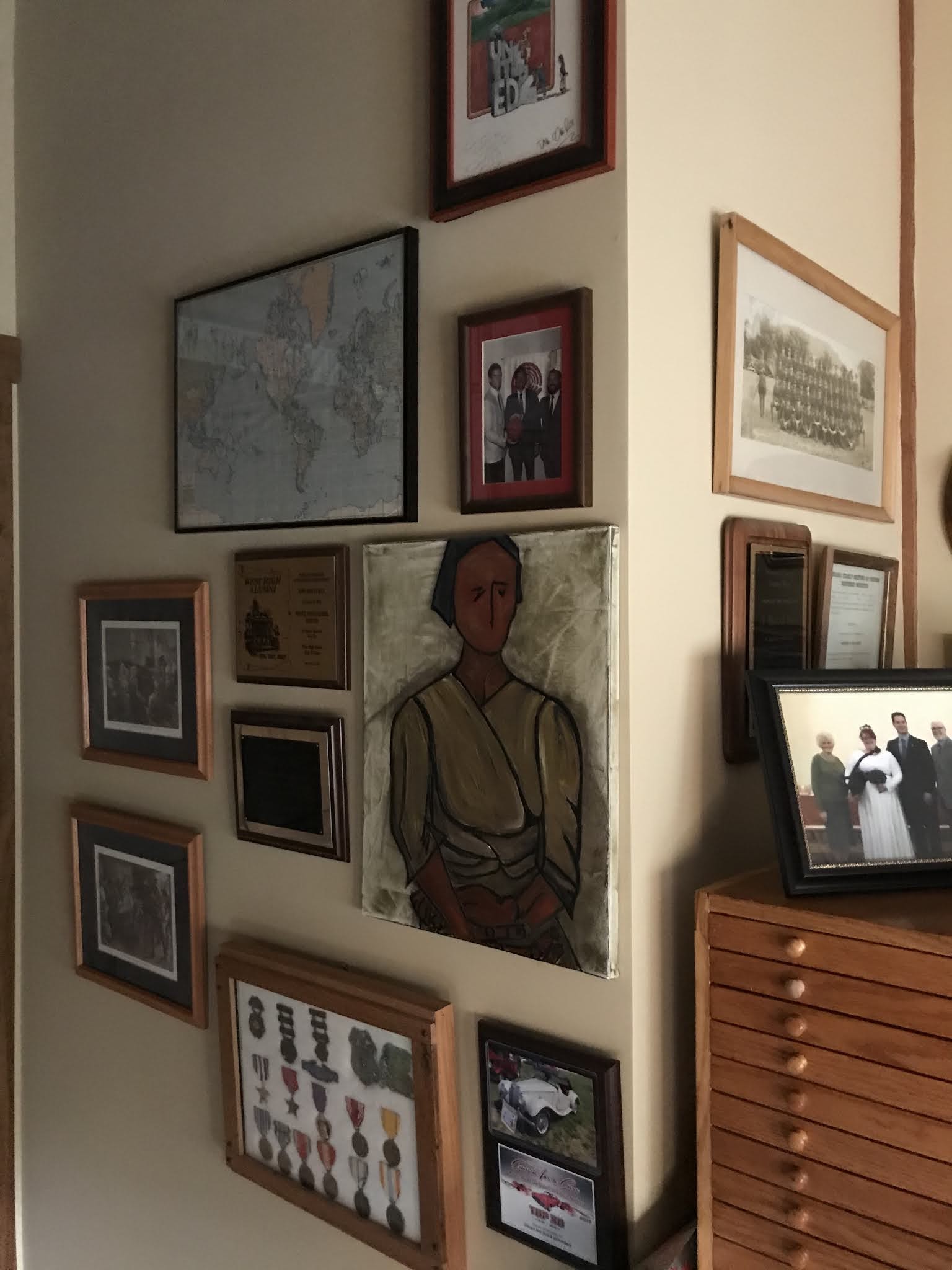
Sitting on the shelves are various Snoopys, models I've built of British sportscars (including a replica of the 1966 Austin-Healey Sprite I once owned), awards I've won exhibiting my 1955 MGTF 1500 at various car shows, and old cameras -- including my dad's 35mm Vivitar and its lenses. Unlikely for a Quaker, there are also old cast iron tanks, a cannon, and a grenade cigarette light -- relics of time I spent with my beloved great-uncle Johnny Clemmens. Some of his Army medals hang on a wall.

The walls are covered with all sorts of photos and certificates. The old Ohio title to the MG from when 

dad gave it to me, a leaf from an early 17th John Bill Bible (a printer relative of mine), a 1973 National Lampoon Map of the World (very unpollitically correct, framed book covers, a painting of Quaker Mary Dyer by my friend Lil Copan. 

In the corner, tucked alongside two file cabinets topped by my dad's old chart chest, is my desk. I had it made almost 20 years ago and still love its aging oak patina. It hold my large format photo printer, laser printer, scanner, stereo speakers and computer. It's where I do almost all of my writing and thinking. 

When I was a kid growing up in Columbus, I dreamt of being a writer and having a space like this. I also was intrigued by the collections various adults in my life had -- Dad and his stuff, including fake business cards that said things such as "If I give you a going away present, will you go away?", Uncle Johnny and his model tanks and record collections, Mom and her books and boxes of family photos. For the past almost 20 years, I've been lucky to have had the writing space I always dreamed of and a place to put my weird collection of stuff. It's been a haven -- a little bit of normal (or abnormal in my case) -- in this scary, dangerous time. 

And a place to further reinforce their grandfather's craziness to my grandchildren. Though they do seem to enjoy playing with the toy cars, Woodstock and Snoopy, the marshmallow shooting air gun, et al. 

"See you 'round like a donut," they say when they leave. Wonder where they got that?


Thursday, September 10, 2020

Time of the Signs: More Midwest Musings

Yesterday morning dawned sunny and coolish for a day when later it turned 90 and humid. So, I thought, I'd better get out and do some work around the farm early.  

My first task was replace the old farm sign. Sixteen years ago, I had a nice handmade wooden sign welcoming people to Ploughshares Farm, the name of our place. Originally, it was a nice stained piece of wood with letting and a picture of a ploughshare on it. Over the years the finish wore off and the wood began to age in not good ways, so we painted the background, repainted the lettering and logo, and edged it in green. 

That worked well for a while, but time, weather, and some wood chewing insects took their toll and as you can see from the top photo the sign was falling apart. Pieces fell off it it regularly and had to propped back into place. So the time came for a new sign. 

I picked the new sign, done by a local shop, up earlier in the week. I loaded up my tools and new the sign in my little utility cart and headed out to the road. Removing the old rotted sign was easy at first. Pieces fell off. But the sign's mounting board proved a bit more difficult. I'd mounted that sign with four 4" deck screws. And they were still holding tight. Besides that, they didn't want to let go. One battery on the drill/screwdriver went dead on the top screw. And some doofus had failed to charge the back up battery. Doh. So I took the batteries back to garage to charge, and picked up a screw driver to get the screws out. 

Twenty minutes and a few breaks later (old men with heart conditions take lots of breaks) the four screws were finally free. And one of the batteries was charged just in time to install the new sign. I figured, after measuring twice (my father's voice in my head) that 3" screws would be plenty long enough. A few more measurements and pencil marks and use of a level, the new sign (bottom picture) was up.

A vast improvement. As I stood there, I looked down the long lane admiring my work and also the work of others at Ploughshares Farm over the years. The east side tree line along the lane had once been a scrum of bushes and trees and old farm fence that my dad, son-in-law Michael, son Tim, and I had chain sawed, hand sawed, and more to clean out and leave about 30 good trees (it's a long lane!). On the west side I saw another almost 30 trees and bushes -- these all planted by Nancy and me fourteen years ago, except two maple trees that had sprouted in Dad and Mom's flower garden. Dad dug them up and brought them 210 miles to our place and planted them. They're now over twenty feet tall. 

The two tree lines form a nice canopy over the lane, a shady (most of the time), pleasant view that leads back into another woods (the lane takes a sharp eastward turn toward our house a third of a mile away. The house can't been seen from the main part of the lane). Though a lot of human labor went into that view, mostly it was nature at work. Trees and bushes did what trees and bushes should do and grew and grew. And I was the beneficiary of their work that day. And, indeed, I am almost every day.  

While I was sad to take the pieces of the old sign down to the burn pile, I was grateful for the way it stood as welcome for a decade and half. It was an invitation to many folks to visit the farm, stay awhile, see its transformation from farmland to prairie and woodland, and enjoy the trails and wildflowers and tall grasses and butterflies and birds and occasional fox, wild turkeys, bunnies, and deer. What they may not have seen is the slow transformation of my soul and life that comes from living and working here. And ike that old sign, I'm older, too. And falling apart a bit more each day -- at least physically. 

But I'm not quite ready for the burn pile!

Now a new stands out by the road. The invitation is still there -- just a bit easier to see with its new paint. It's an invitation I hope you'll take advantage of if you're ever out this way.
 

Monday, August 03, 2009

Rooted and Grounded

I am back home. Home, for me, is the Midwest. In general. Specifically, it's Ohio and Indiana. Ohio is where I grew up and it is still home to me in a way that is very spiritual and yet somehow undefinable. I have been gone from there now more years (barely) than I lived there, but whenever I cross the Ohio-Indiana line and see the arch proclaiming "Welcome to Ohio" or hear Karin Berqquist sing "Ohio" ("I know Ohio like the back of my hand") a sense of melancholy homecoming settles over me.

Just as real, but less melancholic, was the feeling I had flying into Indianapolis yesterday after almost 12 days in Colorado and New Mexico.

Those were glorious days -- vistas that can barely be imagined. In Colorado, I visited my sister Julie and her husband Dave who now live in Montrose. Julie has wanted to live in Colorado ever since she and I were there at Young Life's Silver Cliff Ranch in the late 70s (she as a kid and me as a leader). She says (and I have no reason to doubt her -- knowing both my younger and older self) that as my youngest sister I made her go. But she loved it. And now she and Dave live there. We visited Black Canyon, Ridgway, Ouray and other fascinating places. I took a ton of photographs.

Likewise in Santa Fe and Chimayo. Skies wide open, wispy cloud formations, amazingly colorful desert flowers. What great light.

But. But in the same way that St. Paul tells us that we are to be "rooted and grounded" in [Christ's] love so that we might be filled with the fullness of God, I find that I am rooted and grounded in the Midwestern soil. It speaks to my soul with its lush greenness, multiplicity of flowers and grasses, tall trees, and manageable vistas.

Likewise its people -- generally polite, often understated (if asked how something was, we'll say "Pretty good" or "Not bad" as a high compliment), deeply spiritual -- even if we disagree about what it means to be spiritual. These people, like the land at its best, reflect the goodness of God's love. At our worst, we are like a wicked tornado, shredding everything in our path (and some of that has gone on, I hear, among a gathering of -- of all people -- Quakers this week. I am glad I was in New Mexico for that!).

Regardless. These are my people. This is my home. This is my vision of Heaven -- both here on earth and in Eternity. Good hearted women and men rejoicing (though subtly) in the blessings of God, land abundant and fertile, life a wee bit slower (when I allow it to be), and God feeling near.

I am rooted and grounded in this place.

I hope you feel that way about your place. God be praised. And it's good to be home.

-- Brent