Monday, November 11, 2013

"her great feathered cross..."

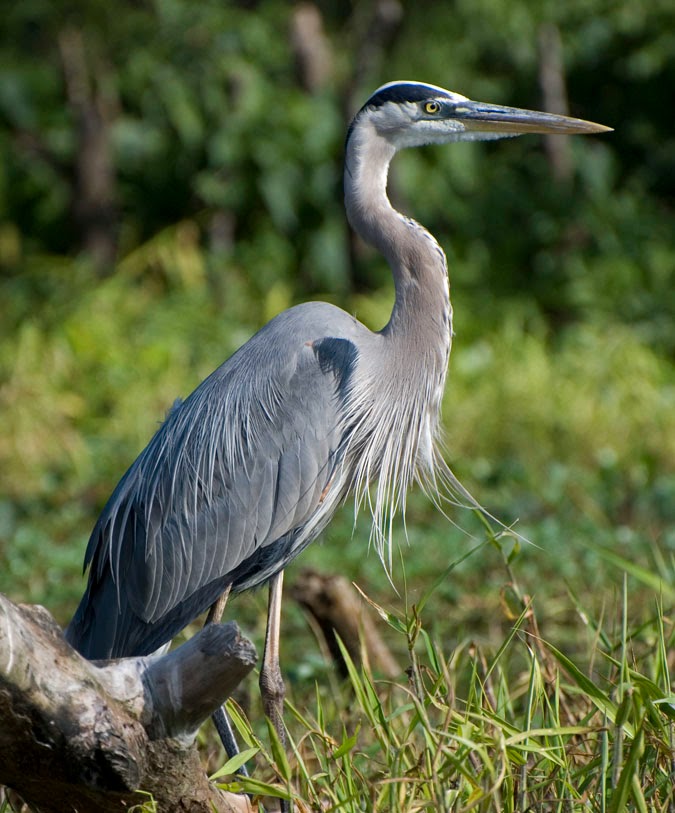
The Heron

Whenever we noticed her
standing in the stream, still
as a branch in dead air, we
would grab our binoculars,
watch her watching,
her eye fixed on the water
slowly making its own way
around stumps, over a boulder,
under some leaves matted against
a fallen log. She seemed
to appear, stand, peer, then
lift one leg, stretch it, let
a foot quietly settle into the mud
then pull up her other foot, settle
it, and stare again, each step
tendered, an ideogram at the end
of a calligrapher's brush.
Every time she arrived, we watched
until, as if she had suddenly heard
a call in the sky, she would bend
her knees, raise her wide wings,
and lift into the welcome grace
of the air, her legs extending
back behind her, wings rising
and falling elegant under the clouds:
For more than a week now
we have not seen her. We watch
the sky, hoping to catch her great
feathered cross moving above the trees.

"The Heron" by Jack Ridl, from Practicing to Walk like a Heron. © Wayne State University Press, 2012  (buy now)
From "The Writer's Almanac"

Monday, November 04, 2013

"Silence and Shots" -- A New Way of Planting Quaker Meetings?

A friends of mine sent me an article on "Church-In-Pub" from NPR the other day with the question, "New idea for New Meetings Project? Just kidding, . . . maybe!"   Since she's the clerk of her meeting, she didn't feel like posting it publicly, though she did note, "I have noticed that the rum soaked cranberry salad always disappears quickly at pitch-ins!"

As I read the article I was reminded a photo my brother-in-law Paul sent me a few months ago (on the left).  "Spiritual Shots" in Frisco, TX.


The article reports "With mainline religious congregations dwindling across America, a scattering of churches is trying to attract new members by creating a different sort of Christian community. They are gathering around craft beer. ... Some church groups are brewing it themselves, while others are bring the Holy Mysteries to a taproom. The result is not sloshed congregants; rather, it's an exploratory approach to do church differently."

Doing church differently is something that Quakers have been doing for years.  Well, differently from other Christian congregations.  Perhaps, though, it's time to begin to do something differently from where we've been doing it.

Notice I said "where," not "how."

I think we've got a good bit of the "how" correct -- when we do it right.  But lately we've been largely locked into worshiping in the sort of place that our founding Friends railed against -- a set building.  A "steeple-house" as Fox referred to the churches of his day.  I wonder what he would say about our meetinghouses today?  True, few of them have steeples, per se, but have they become a hindrance rather than a help in being Friends?


Now I admit, I truly love our little meetinghouse.  There's comfort there.  Community there.  Deep worship there.  But I also note that there are few visitors there.

And so when I read the NPR article, I remembered John Camm and John Audland preaching where ever they could -- including the pubs of the day.  They went to where the great people to be gathered were already gathering.

Hmmm, that's a thought.  To take the Quaker way to places where people who would be sympathetic to our way of faith and life are already present or disposed to visit.  "Quakers at the Co-op"?  "Spirit at Starbucks" (whilst Starbucks may not be thrilled w/ a bunch of coffee-swilling Quakers, that's who they're named for (Starbuck in "Moby Dick")?  "Silence and Shots" at the local craft distillery?  Well, we're probably not ready for that or to serve Old Quaker Whiskey.

But what are we ready for?  And where are we ready for?  Is it time to go where "they" are rather than wait for "them" to come to where we are?  Where we are may be fine for us already gathered.  In fact, it may be the perfect place from which to launch an outreach effort at the natural foods cafe, jazz club, playhouse, bookstore, etc.  And where we are may be ideal for folks who are attracted to the Quaker way through our efforts at those public places -- it may be just perfect for entering a loving, caring, worshipful community of faith and going deeper spiritually.

Where is Spirit calling you?

-- Brent

Thursday, October 31, 2013

"Better Food for a Better World": A Book Review

I first "met" Erin McGraw via her short story collection Lies of the Saints.  I was browsing through Eighth Day Books (one of the best independent bookstores in the universe) and came across this quirky title (I'm a sucker for quirky titles -- among other things).  I snatched it up and read it straight through.  I read it again -- hooked by McGraw's lively writing, intriguing characters, and stories with a twist.

I've read everything by her since.

So I was delighted to hear that she had a new novel out -- Better Food for a Better World.  My delight has not dissipated after reading it.  McGraw continues to be a first rate writer and she's well able to sustain a novel.

The premise doesn't sound all that exciting.  Three couples from college pool their financial and emotional resources to start "Natural High Ice Cream" with the goal of providing "Better Food for a Better World." Hey, I don't even like ice cream that much (mostly because I can't eat the real stuff thanks to diabetes).  And it hardly sounds "life or death"ish. 

But then I didn't count on the "Life Ties" marital un-support group they belong to or chubby contortionists or flirtations over ice cream and wine or...   Well, you'll just have to read it to see what other "or"s there are.  It truly is a matter of life and death -- just not in the physical way, so much.

McGraw's writing draws you in, up, and over -- just like her lives of these non-saints.  They are saint-wanna-be's sort of -- but of the vaguely spiritual, not religious type of saints.  They're good people who just can't seem to be good.   Just like all of us, they're women and men caught up in the holy ordinary of life and missing both the holiness and the blessing of ordinariness. 

Of course, their ordinariness is not most of our ordinarinesses -- few of us book feminist comics, struggle with teaching violin, devise healthy ice cream recipes with Ben & Jerry-ish names, or participate in self-help groups that abound with a certain sarcastic saintliness.  But Vivy, Sam, Nancy, Paul, Cecelia and David finally see the blessings of their lives amidst the trials -- and, when they do, help us see our own.

Thanks, Erin!


Wednesday, October 30, 2013

"bagging gold for the cold days to come..."

Neighbors in October

All afternoon his tractor pulls a flat wagon
with bales to the barn, then back to the waiting
chopped field. It trails a feather of smoke.
Down the block we bend with the season:
shoes to polish for a big game,
storm windows to batten or patch.
And how like a field is the whole sky now
that the maples have shed their leaves, too.
It makes us believers—stationed in groups,
leaning on rakes, looking into space. We rub blisters
over billows of leaf smoke. Or stand alone,
bagging gold for the cold days to come. 

"Neighbors in October" by David Baker, from The Truth About Small Towns. © University of Arkansas Press, 1998.  (buy now) 

From "The Writer's Almanac"

Saturday, October 26, 2013

"now the eyes of my eyes are opened"


photo by Brent

i thank You God for most this amazing


i thank You God for most this amazing
day: for the leaping greenly spirits of trees
and a blue true dream of sky; and for everything
which is natural which is infinite which is yes

(i who have died am alive again today,
and this is the sun's birthday; this is the birth
day of life and of love and wings: and of the gay
great happening illimitably earth)

how should tasting touching hearing seeing
breathing any—lifted from the no
of all nothing—human merely being
doubt unimaginable You?

(now the ears of my ears awake and
now the eyes of my eyes are opened)

"i thank You God for most this amazing" by E.E. Cummings, from 100 Selected Poems. © Grove Press, 1994. (buy now) 

From "The Writer's Almanac"

Wednesday, October 23, 2013

"In moons that rise up everywhere..."

The Old Woman Gets Drunk with the Moon


The moon is rising everywhere;
The moon's my favorite easy chair,
My tin pot-top, my green plum tree,
My brassy buttoned cavalry
Tap-dancing up a crystal stair.

O watch them pitch and take the air!
Like shoo fly pies and signal flares,
Like clotted cream and bumblebees,
The moons are rising.

How hits-the-spot, how debonair,
What swooned balloons of savoir faire,
What purr of rain-blurred bright marquees
That linger late, that wait for me,
Who'll someday rest my cold bones there
In moons that rise up everywhere. 

"The Old Woman Gets Drunk with the Moon" by Hailey Leithauser, from Swoop. © Graywolf Press, 2013.  (buy now) 

From "The Writer's Almanac"

Range, Loathing, y Tuscon, AZ -- A montage of music, visuals, and poetry

Forms of Range and Loathing
by Ruth Ellen Kocher

typical of an arid country among hundreds of other flora
you find half a province of avalanches 
parts are desert 
I might say light defeated by a dark thing that strips
mountain and bullet
no 
the mountains have forgotten airborne
you would never say howl
never say mountain
or region or enemy
you say men's mouths are the woods' black holes 
I'm thinking The guy on TV didn't seem upset about
killing his wife If he'd done so but he didn't he says 
nothing about him if not after an interview
tuft bodies of red wings scatter the lawns 
did you hear
birds out of sky
some dead wind

he didn't seem upset and so may as well
have killed his wife
a jury says
If you could hear me now I'm not sure how important
it might seem In another language
Hope is not too much or that a random crime
might mean We share something 


Copyright © 2013 by Ruth Ellen Kocher.
Ruth Ellen Kocher is the author of several books of poems, including domina Un/blued 
(Tupelo Press, 2013). She teaches in the M.F.A. program at the University of Colorado-Boulder.


Tuesday, October 22, 2013

"We all give God the blues..."

"Behind the wall a garden still in blossom..."

Photo by Brent

The Lost Garden


If ever we see those gardens again,
The summer will be gone—at least our summer.
Some other mockingbird will concertize
Among the mulberries, and other vines
Will climb the high brick wall to disappear.

How many footpaths crossed the old estate—
The gracious acreage of a grander age—
So many trees to kiss or argue under,
And greenery enough for any mood.
What pleasure to be sad in such surroundings.

At least in retrospect. For even sorrow
Seems bearable when studied at a distance,
And if we speak of private suffering,
The pain becomes part of a well-turned tale
Describing someone else who shares our name.

Still, thinking of you, I sometimes play a game.
What if we had walked a different path one day,
Would some small incident have nudged us elsewhere
The way a pebble tossed into a brook
Might change the course a hundred miles downstream?

The trick is making memory a blessing,
To learn by loss the cool subtraction of desire,
Of wanting nothing more than what has been,
To know the past forever lost, yet seeing
Behind the wall a garden still in blossom. 

"The Lost Garden" by Dana Gioia, from Interrogations at Noon. © Graywolf Press, 2001.  (buy now) 

From "The Writer's Almanac"

Thursday, October 17, 2013

"Gone"

Photo by Brent
Gone
 
by Lia Purpura
 
 
It's that, when I'm gone, 
(and right off this is tricky) 
I won't be worried 
about being gone. 
I won't be here 
to miss anything. 
I want now, sure, 
all I've been gathering 
since I was born, 
but later 
when I no longer have it, 
(which might be 
a state everlasting, who knows?) 
this moment right now 
(stand closer, love, 
you can't be too close), 
is not a thing I'll know to miss. 
I doubt I'll miss it. 
I can't get over this.


Copyright © 2013 by Lia Purpura. 

Lia Purpura is the author of seven collections of poems, essays, and translations, including King Baby (Alice James Books, 2008). She is Writer in Residence at the University of Maryland, Baltimore, and on the faculty of the Rainier Writing Workshop. She lives in Baltimore, Maryland. Purpura will be on a panel titled "The Poetic Impulse" at the Academy's Poets Forum in New York City, October 24-26.  

"...thirsty, happy poems."


The late, great Princess of Ploughshares

The Poetry Teacher


The university gave me a new, elegant
classroom to teach in. Only one thing,
they said. You can't bring your dog.
It's in my contract, I said. (I had
made sure of that.)

We bargained and I moved to an old
classroom in an old building. Propped
the door open. Kept a bowl of water
in the room. I could hear Ben among
other voices barking, howling in the
distance. Then they would all arrive—
Ben, his pals, maybe an unknown dog
or two, all of them thirsty and happy.
They drank, they flung themselves down
among the students. The students loved
it. They all wrote thirsty, happy poems. 


"The Poetry Teacher" by Mary Oliver, from Dog Songs. © Penguin, 2013.  (buy now) 

From "The Writer's Almanac"

Thursday, October 10, 2013

"With quiet eyes..."

Photo by Brent

Afternoon on a Hill

I will be the gladdest thing
   Under the sun!
I will touch a hundred flowers
   And not pick one.

I will look at cliffs and clouds
   With quiet eyes,
Watch the wind bow down the grass,
   And the grass rise.

And when lights begin to show
   Up from the town,
I will mark which must be mine,
   And then start down!

"Afternoon on a Hill" by Edna St. Vincent Millay, from Selected Poems. © Harper Perennial, 1991.

From "The Writer's Almanac"

Tuesday, October 08, 2013

"The Rules of the New Car"

The Old Car

The Rules of the New Car

After I got married and became
the stepfather of two children, just before
we had two more, I bought it, the bright
blue sorrowful car that slowly turned
to scratches and the flat black spots
of gum in the seats and stains impossible
to remove from the floor mats. "Never again,"
I said as our kids, four of them by now,
climbed into the new car. "This time,
there will be rules." The first to go
was the rule I made for myself about
cleaning it once a week, though why,
I shouted at the kids in the rearview mirror,
should I have to clean it if they would just
remember to fold their hands. Three years
later, it was the same car I had before,
except for the dent my wife put in the grille
when, ignoring the regulation about snacks,
she reached for a bag of chips on her way
home from work and hit a tow truck. Oh,
the ache I felt for the broken rules,
and the beautiful car that had been lost,
and the car that we now had, on soft
shocks in the driveway, still unpaid for.
Then one day, for no particular reason except
that the car was loaded down with wood
for the fireplace at my in-laws' camp
and groceries and sheets and clothes
for the week, my wife in the passenger seat,
the dog lightly panting beside the kids in the back,
all innocent anticipation, waiting for me
to join them, I opened the door to my life. 

"The Rules of the New Car" by Wesley McNair, from Lovers of the Lost: New and Selected Poems.

From "The Writer's Almanac"

Monday, October 07, 2013

"the radiant world...."

Sailing on Lake Superior

Before us now the edge of the earth,
below us the nearly endless cold.
Around us nothing but shimmering
water,
the miles of empty and sparkling blue.

For a few hours, the sail fills on
toward infinity. Shadows of
our delicate bodies ebb and flow
across the deck of our delicate boat.

What if the beautiful days, the good
and pacific temperate moments,
weren't just lovely, but everything?
What if I could let it fall away
in the wake, that ache to extract
meaning from vastness?

Let this suffice; the ease of thinking
it all goes on, whether we're here
to see it or not. The splashing waves,
the suntipped gulls arcing across
the radiant world.

"Sailing on Lake Superior" by Kirsten Dierking, from Northern Oracle. © Spout Press, 2007.

From "The Writer's Almanac"

Sunday, October 06, 2013

A Grace: Poem

A Grace


God, I know nothing, my sense is all nonsense,
And fear of You begins intelligence:
Does it end there? For sexual love, for food,
For books and birch trees I claim gratitude,
But when I grieve over the unripe dead
My grief festers, corrupted into dread,
And I know nothing. Give us our daily bread.

"A Grace" by Donald Hall, from Old & New Poems. © Ticknor & Fields, 1990

From "The Writer's Almanac"

Saturday, October 05, 2013

The Necessity for Irony: A Poem


The Necessity for Irony

On Sundays,
when the rain held off,
after lunch or later,
I would go with my twelve year old
daughter into town,
and put down the time
at junk sales, antique fairs.

There I would
lean over tables,
absorbed by
lace, wooden frames,
glass. My daughter stood
at the other end of the room,
her flame-coloured hair
obvious whenever—
which was not often—

I turned around.
I turned around.
She was gone.
Grown. No longer ready
to come with me, whenever
a dry Sunday
held out its promises
of small histories. Endings.

When I was young
I studied styles: their use
and origin. Which age
was known for which
ornament: and was always drawn
to a lyric speech, a civil tone.
But never thought
I would have the need,
as I do now, for a darker one:

Spirit of irony,
my caustic author
of the past, of memory,—

and of its pain, which returns
hurts, stings—reproach me now,
remind me
that I was in those rooms,
with my child,
with my back turned to her,
searching—oh irony!—
for beautiful things. 

"The Necessity for Irony" by Eavan Boland, from The Lost Land. © W.W. Norton.
From "The Writer's Almanac"

Friday, October 04, 2013

A Novel by a Spiritual Non-Fiction Writer Set in Central America? Twenty Years Ago? Really?? -- A Guest Post by Writer Paula Huston


Paula Huston is the author of the newly released novel A Land Without Sin.  She is also the author of Simplifying the Soul: Lenten Practices to Renew Your Spirit, The Holy Way: Practices for a Simple Life (both of which I highly recommend), and many other books.  I invited her to write about A Land Without Sin.

**************

I’ll admit, it does sound a little far-fetched.  But there is a back-story here.  In fact, I was a fiction writer long before I began writing books like THE HOLY WAY.  I wanted to be a novelist from the time I was about seven years old, and actually began practicing way back then by writing a 36-page thriller about King the Dog, a super-canine hero who looked and acted an awful lot like Rin Tin Tin.  I took creative writing in high school, but got really serious about short story writing in my early twenties.  Since I had opted to get married and take on a full-time job in my late teens rather than go to college, I had no formal training, but I soon figured out that the library was full of great teachers.  I checked out all the BEST AMERICAN SHORT STORY anthologies I could get my hands on and studied the techniques of my favorite writers.


I sold my first story to a literary journal when I was about thirty, and by the time I actually went to college four or five years later (I’d been through a divorce by then, along with an eye-opening stint as a single mom, so I was more than convinced it was time to get a degree), I’d published quite a few of them.  A few years later, now remarried, a new step-mom, and armed with a Master’s in Literature degree, I got a job teaching at the local university and began trying to put together my first short story collection.  But one of the pieces, which was about the classical piano world at Peabody Conservatory in Baltimore, began to grow  uncontrollably, and pretty soon I realized I had an infant novel on my hands.  DAUGHTERS OF SONG  was published by Random House in 1995.

A year before it came out, however, my husband Mike and I made a backpacking trip to the jungles of Central America to see the Maya ruins.  We had just left southern Mexico for Guatemala when the Zapatista Uprising in Mexico began.  Like a lot of Americans, I knew very little about this part of the world, but this close brush with a revolution triggered an intense curiosity.  And that got coupled with my already-intense interest in the Mayas (my first major, before I switched to literature, had been anthropology).  I asked Random House if I could substitute a novel about all of this for the short story collection they’d planned to publish next.  They gave me the go-ahead and I spent the next three years researching and writing the book.  One of the biggest disappointments of my life came the day they informed me they’d decided not to publish it after all.  I stuck it away in a box and tried to forget about it.

Meanwhile, I met an editor-turned-agent at a writers’ conference who listened to my sad story and suggested I try writing spiritual nonfiction.  I resisted at first, but he was a great mentor, pointing me to wonderful spiritual writers I’d never read and eventually becoming my new agent.  It was his suggestion that I write a book about the simple life, the book that became THE HOLY WAY.   Much to my surprise, I found that I really liked writing nonfiction--it seemed refreshingly straightforward compared to fiction writing, which must always tell the truth but tell it “slant,” as Emily Dickinson puts it.  By the time I published my sixth book in this genre, I’d pretty well abandoned any notion of returning to fiction writing.

But one day a year or so ago I got an email from an old friend, a Christian editor who was starting a new literary imprint called, ironically enough, SLANT.  He asked if I had “any old novels lying around.”  I did!  And eighteen long years after I’d stuck it away and nearly forgotten about it, I dragged out that dusty old draft and reread it--and fell in love with it all over again.  Greg Wolfe, the Christian editor in question, liked it too.  He asked me some great editorial questions that helped me launch into a major revision, and a year or so after that initial email, A LAND WITHOUT SIN finally saw print.

How does it feel to hold this long-delayed book in my hands?  Surprisingly enough, I’m very grateful Random House did not publish it back then.  I learned so much during those many years of writing spiritual nonfiction.  First, I did not have any formal training in theology or divinity, so I had to educate myself in those areas--which made it possible, for example, for me to write much more believably about the struggles of a young priest to come to terms with the question of evil.  Second, when I wrote that first draft back in the early 90‘s, I was a very recent returnee to Christianity, still wet behind the ears, and this naive inexperience showed up as a certain kind of preachiness in that earlier version.  And finally, like a lot of people in their sixties, I’ve said goodbye to some of my youthful idealism by now--and I think this makes me a stronger, more realistic, and more truthful writer than I used to be.  Certainly a better writer for a book like this one, packed as it is with The Big Questions and their Not-So-Easy Answers.   
Thursday, October 03, 2013

Living in a Time of Great Spiritual Awakening: A Conversation Among Friends

Are we living in a time of troubling trends?
• declining church/meeting attendance,
• dissatisfaction with institutional religion,
• the rise of “None” as the most common religious affiliation on surveys
• a feeling that old structures and programs don’t hold the new Life?”

Or, are we in a time of dynamic Spiritual Awakening and renewal?

Want to be part of the conversation??  If so, join us --